 Skip-the-line available
 The Bronze Juliet: The Full Story of Verona's Most-Touched Statue
Nereo Costantini's Juliet has been rubbed for luck by millions of hands — so many that the city had to retire her. Here is the whole story, from casting to replica, and how to meet her well.
Every day, in the small courtyard below the balcony, a queue forms beside a bronze girl. Visitors rest a hand on her right breast, look at the camera, and smile — repeating a gesture performed so many millions of times that it physically wore through the original statue and forced Verona to swap her for a copy. The bronze Juliet is the youngest of the major traditions at Casa di Giulietta and, in some ways, the most revealing: a statue of a fictional teenager, sculpted in 1968, installed in the 1970s, loved literally to destruction by 2014, and now standing in replica while the battered original rests indoors. This guide tells her full story — sculptor, patrons, the strange evolution of the luck ritual, the replica swap — and finishes with practical advice for meeting her in the courtyard's timed-entry era, when the photo queue is shorter and better-behaved than it has been in decades.
A Statue for a Girl Who Never Existed
The bronze Juliet is the work of Nereo Costantini, a Veronese sculptor who modelled her in 1968 with financial backing from the Lions Club of Verona, the civic association that gifted the work to the city. Costantini's Juliet is not a theatrical figure caught mid-drama; she stands quietly, slim and straight-backed, her dress falling in simple lines — a deliberately timeless young woman rather than a costume-drama heroine. Verona tradition connects her design to a much older local muse: the medieval Madonna Verona, the ancient statue crowning the fountain in Piazza delle Erbe, the city's civic emblem since the 14th century. Costantini's bronze reads as a young descendant of that figure — Verona personified at sixteen.
It is worth registering how unusual the commission was. Cities raise statues to generals, saints and poets; Verona raised one to a character from someone else's play — and not even at a documented site, but in the courtyard of a former inn that a 1930s curator had dressed as her home. The statue was, in effect, the final furnishing of Antonio Avena's stage set: the courtyard had the balcony, the Gothic detailing and the crowds, and now it had Juliet herself, permanently at home to receive them. No one involved pretended otherwise, and that honesty is part of the work's charm. She is not a memorial. She is a welcome.
The statue did not go straight to the courtyard. Her early public life included display at Palazzo Forti, the city's exhibition palace, before she was moved to the Casa di Giulietta courtyard, where she was installed in her permanent position on 1 June 1973. From that day the courtyard's modern visitor ritual began to assemble itself around her — first the photographs, then, gradually, the touch.
How the Luck Tradition Actually Started
The custom every visitor now knows — touch Juliet's right breast and you will be lucky in love — has no ancient pedigree whatsoever. It grew up informally around the statue in the decades after 1973, apparently seeded by tour-guide patter and the simple, observable fact that bronze polishes where hands go. As the right breast brightened against the darkening patina, the shine itself became the instruction: each visitor could see exactly where previous visitors had touched, and the feedback loop closed. By the 1990s the gesture was universal, photographed millions of times a year, and as fixed in the visitor liturgy as the balcony photo above it.
Traditions of touching statues for fortune are old and widespread — worn saints' feet and rubbed animal snouts dot Europe — and the Juliet ritual borrowed that grammar and attached it to romance, the one kind of luck this courtyard could plausibly dispense. What makes the Verona case remarkable is the speed and scale. A ritual younger than colour television acquired, within a single generation, the outward appearance of an immemorial custom, complete with earnest debates about its origins. Guides at the site who claim medieval roots for it are improvising; guides who date it to living memory are telling the truth, and the truth is more interesting — you can watch an invented tradition still in its first century, mid-invention.
The queue itself became part of the experience. On busy afternoons under the old free-courtyard regime, the line to touch the statue could dominate the entire space, with the crowd pressing around picture-takers and the bronze at the centre of a permanent scrum. If you visited before 2026 and remember chaos, it was the statue queue, more than the balcony, that produced it. The timed-entry system has calmed the courtyard dramatically — but the ritual continues, wave after 15-minute wave.
Loved to Destruction: Why the Original Had to Retire
Bronze is durable, but it is not infinite. Four decades of daily handling — concentrated, with anatomical precision, on one small area — polished, thinned and finally breached the metal. By the early 2010s conservators documented serious wear on the original statue: the right breast had developed a visible fissure and eventually a small hole, the arm showed cracking, and the accumulated micro-damage of tens of millions of touches had outrun any realistic repair-in-place. The statue had become a conservation paradox: the behaviour that made her beloved was destroying her, and no signage was ever going to stop it.
Verona's solution, in 2014, was pragmatic: retire the original and let a faithful bronze copy take the punishment. The replica was cast and set on the courtyard plinth, where visitors have been polishing it ever since — the right breast of the copy is already bright, which tells you everything about the futility of asking the ritual to stop. The original Costantini bronze was moved inside the Casa di Giulietta complex, where she stands protected from further handling, her worn breast and its small hole preserved as found — a strangely moving artefact, the physical record of forty years of hope pressed into metal by strangers.
The 2014 swap makes the courtyard statue one of the most honest objects on the site. Nothing about her pretends: she is a declared copy, standing in for an original that visitors' affection consumed, in a courtyard designed in 1939, attached to a house that borrowed its name from an innkeeper's sign. Purists sometimes sniff at the layers of reproduction. But there is a good argument that the replica is the truest thing in the courtyard — a working statue doing exactly the job the city cast her for, absorbing love on behalf of a fictional girl so that a real artwork can survive it.
Juliets Around the World
Costantini's Juliet turned out to be an export product. Copies and derivatives of the Verona bronze stand in several cities — Munich, San Francisco, Chicago and Bangkok among them — most of them gifts or twinning gestures carrying Verona's romance franchise abroad. Munich's Juliet, presented by Verona, receives flowers and touches outside the city hall; the North American and Asian copies anchor their own local photo rituals. For a provincial sculptor's civic commission, it is an extraordinary afterlife: the same slim figure, multiplied across three continents, performing the same duty everywhere — standing still while strangers confide in her.
The diaspora also clarifies what the Verona original actually is: the mother statue of a global gesture. Visitors who have met a Juliet elsewhere will recognise the choreography in the Casa di Giulietta courtyard instantly, and there is real pleasure in completing the pilgrimage at the source — this plinth, under this balcony, is where the ritual was born and where it operates at full intensity. If the courtyard bronze is a copy, she is a copy standing on the original stage, which no overseas Juliet can claim.
Inside the house, the retired original offers the collector's-item version of the encounter: the actual 1968 bronze, wear and all. Seeing both in one visit — the working replica outside, the worn original within — is quietly the best single argument for taking the full house entry rather than the courtyard-only level, and most visitors who know the story do exactly that.
Meeting Juliet Well: Photos, Etiquette and Timing
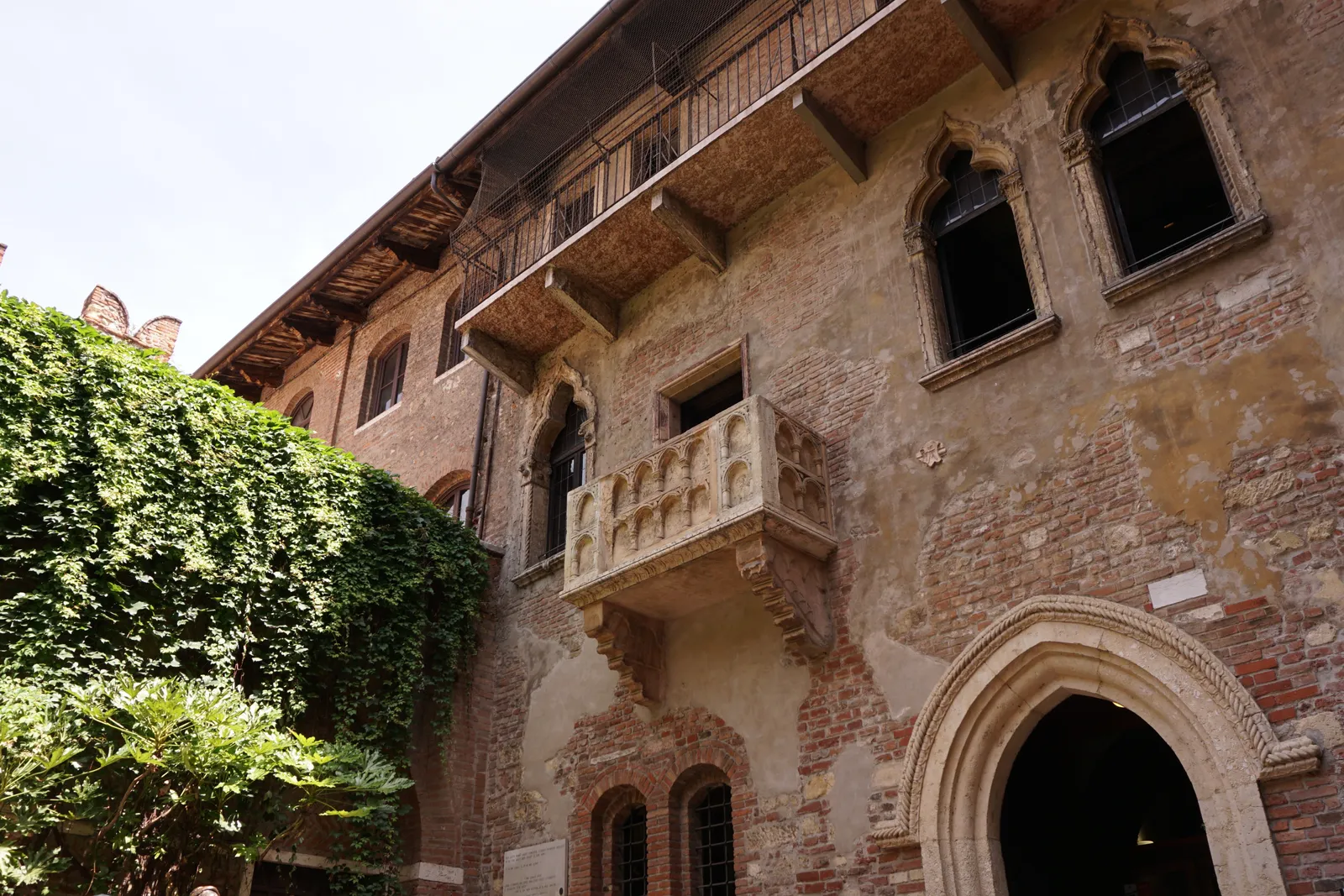
The mechanics first. The statue stands on a low plinth on the courtyard floor, balcony above and slightly behind — so the classic composition, statue in the foreground with the balcony over her shoulder, is shot from the courtyard's entrance side. Under the timed-entry system each 15-minute admission wave produces its own short queue beside her; join it early in your wave and you will usually get an unhurried turn before the next wave arrives. Morning slots put direct light on the balcony wall in fair weather; from mid-afternoon the courtyard falls into soft shadow that flatters the bronze and removes the harsh contrast — photographers with a preference should book their slot accordingly.
Etiquette has tightened in the replica era, and the site is better for it. Touch, by all means — the copy exists precisely to be touched — but the brief, one-hand, photo-and-move-on gesture is the accepted form; climbing the plinth, hanging on the statue's arm or extended posing sessions will draw a steward's whistle and the quiet resentment of everyone behind you. The courtyard is small, your wave shares it with a few dozen people, and the difference between a pleasant rotation and a bottleneck is each group taking thirty seconds instead of three minutes. Children, incidentally, tend to be the best-behaved participants; the statue is exactly child-height for a handshake.
If you want Juliet nearly to yourself, the arithmetic is the same as for the balcony: book the first slot of the day — 09:00 Tuesday to Sunday, 14:00 on Monday — or the last entries from about 17:30, when coach groups have gone and the waves run thin. And spare two minutes, before you leave, for the letters. The courtyard wall and the writing desk inside continue the same conversation the statue hosts: strangers telling a fictional girl true things. Touch the bronze, read a few letters, and the site's real subject — the seriousness with which people take love — is suddenly not silly at all.
Frequently asked
Who made the Juliet statue and when?
Veronese sculptor Nereo Costantini modelled the bronze in 1968, with the Lions Club of Verona financing the work as a gift to the city. After early display at Palazzo Forti, the statue was installed in the Casa di Giulietta courtyard on 1 June 1973.
Is the statue in the courtyard the original?
No. Since 2014 the courtyard statue has been a faithful bronze replica. Decades of the touching tradition wore through the original — including a small hole worn into the right breast — so the city retired her indoors and set the copy on the plinth to absorb the ritual.
Where is the original Juliet statue now?
Inside the Casa di Giulietta complex, protected from further handling, with the wear of forty years of touches preserved. Seeing the worn original inside and the working replica outside in one visit is one of the best reasons to choose full house entry over the courtyard-only level.
What is the touching tradition, and is it really old?
Visitors touch the statue's right breast for luck in love. The custom is genuinely modern — it grew up informally in the decades after the 1973 installation and was universal by the 1990s. It borrows the old European grammar of rubbing statues for fortune, but this particular ritual is younger than the statue herself.
Are there copies of the Juliet statue in other cities?
Yes — versions of Costantini's Juliet stand in several cities including Munich, San Francisco, Chicago and Bangkok, mostly civic gifts from Verona. The Verona courtyard remains the origin of the tradition, and the only place where the statue stands beneath the balcony.
When is the best time to photograph the statue?
First slot of the day (09:00 Tuesday-Sunday, 14:00 Monday) or the final entries from about 17:30, when admission waves are thinnest. Mornings give direct light on the balcony wall; from mid-afternoon the courtyard's soft shade flatters the bronze. Each 15-minute wave forms its own short queue, so join it early in your slot.