 Skip-the-line available
 Courtyard or Full House? What Each Casa di Giulietta Entry Includes
Since April 2026 even the courtyard needs a booked slot. Here is exactly what each access level covers, what waits on each floor of the house, and how to work the balcony photo.
For decades the deal at Casa di Giulietta was simple: the courtyard was free and chaotic, and a ticket bought you the house. That era ended on 1 April 2026, when Verona moved the entire site — courtyard included — behind a single booked entrance through the Teatro Nuovo on Piazzetta Navona. Every visitor now chooses between two access levels: the courtyard visit, which brings you through the theatre's halls to the statue, the letters wall and the balcony seen from below; and the full visit, which adds the house museum itself — three floors of the medieval tower, the frescoed rooms, the Zeffirelli film exhibit, the retired original statue, and the chance to stand on the balcony rather than under it. This guide sets out honestly what each level includes, what is genuinely inside the house floor by floor, how the crowd now flows, and the small mechanics that make the difference between a rushed photo stop and one of Verona's most quietly enjoyable hours.
The End of the Free Courtyard — and Why It Happened
Under the old regime, the little courtyard off Via Cappello was one of the most congested free spaces in Italy: an unmanaged funnel where day-trippers, tour groups and photo queues compressed into a few hundred square metres, spilling back through the entrance tunnel into the street. The move to managed entry was Verona's answer. Since 1 April 2026, access to both the courtyard and the house runs exclusively through the Teatro Nuovo on Piazzetta Navona — the theatre built onto the block in the 1930s — with admission in short timed waves. The historic Via Cappello door no longer admits visitors, a change that still catches out travellers following older guidebooks to the wrong address.
Booking is now the whole game. Entry is by reserved time slot, arranged online in advance through the city's museum ticketing platform — there is no ticket office at the door, and a reservation is required even for visitors entitled to free admission, VeronaCard holders included. In practice this rewards exactly the kind of traveller who plans a morning around a booked slot and punishes the spontaneous walk-up, which is a genuine change of character for a site that was once the definition of an impulse stop. Slots at popular times fill ahead — book before you travel, not from the pavement outside.
The compensation is real: the courtyard experience has improved beyond recognition. Each wave of visitors gets the space at a survivable density, the statue queue resolves itself within minutes, and the entrance through the Teatro Nuovo's halls gives the visit a sense of arrival the old street funnel never had. Whatever one thinks of ticketing a courtyard that was free for a century, the space itself has not been this pleasant to stand in for decades.
What Courtyard Entry Includes
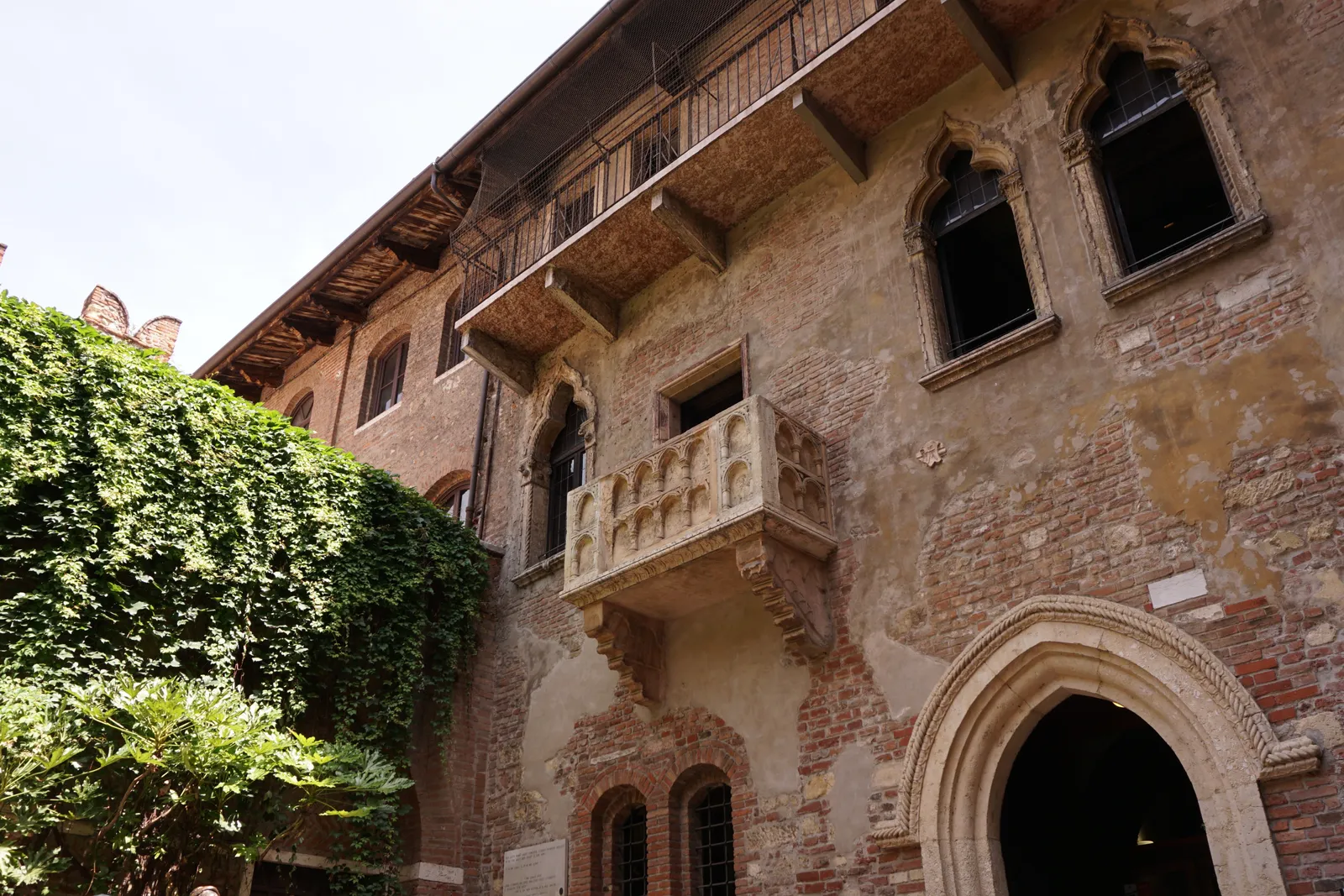
The courtyard-level visit covers three things, and it is worth being precise about them. First, the Teatro Nuovo itself: your route runs through the 19th-century theatre's monumental halls and foyer, which now function as the site's reception — a short but genuine piece of architecture that older visits never showed. Second, the courtyard proper: the bronze Juliet replica on her plinth, the letters wall where notes to Juliet accumulate, the carved Cappello hat on the arch, and the balcony overhead — photographed, like almost everything here, from below. Third, time: your wave gives you a comfortable stay in the courtyard, and nobody sweeps you out the moment your 15 minutes of admission window passes.
What the courtyard level does not include is any interior of the medieval house. The balcony is visible but not walkable; the statue you touch is the 2014 replica, with the worn original standing indoors beyond your reach; the frescoed rooms, the film costumes and the museum's upper windows over the courtyard all sit on the other side of the house door. For a substantial share of visitors this is a perfectly honest purchase — if your ambition is the courtyard scene, the statue touch and the balcony photo, the courtyard level delivers all three, and delivers them far more calmly than the free courtyard ever did.
The candid test is this: if you can name two things you want to see inside the house, take the full visit; if you cannot, the courtyard level will not feel thin. Couples on a whistle-stop Verona circuit, families with a tight lunch reservation and photographers who only want the classic composition all do well at courtyard level. Anyone with an hour to spend, an interest in how this strange site actually works, or a wish to stand where the photographs point should read the next section.
What the Full House Visit Adds, Floor by Floor
The house door opens off the courtyard, and the museum climbs the original tower from there. The lower rooms hold the frescoed heart of the visit: chambers dressed with Veronese frescoes — part original, part restoration — alongside 19th-century paintings of the legend, including Cosroe Dusi's 1838 canvas of the lovers, and period furnishings chosen to evoke a well-to-do Renaissance household rather than to reconstruct any documented interior. Panels trace the real history: the Cappello inn, the 18th-century identification, Antonio Avena's 1939-1940 remodelling. The retired original bronze Juliet, worn breast and all, stands indoors here — for many visitors the single most affecting object in the building.
The middle floor belongs to the story's screen life. The centrepiece is the exhibit built around Franco Zeffirelli's 1968 film of Romeo and Juliet: the celebrated bed from the film — the reason this level is sometimes nicknamed the bedroom floor — together with costumes from the production displayed against the medieval brick. It is an inspired pairing: the film gave the 20th century its defining images of the story, and seeing its wardrobe inside the house that gave the story its address closes a loop. A writing desk on the visit route invites you to leave your own message to Juliet, feeding the same correspondence the courtyard wall and the volunteer secretaries sustain.
And then the balcony. From the first-floor room behind it you step out through the very windows every courtyard photographer is aiming at, and spend your turn above the scene — a minute or two at busy times, longer when the waves run thin — looking down on the statue, the letters wall and the upturned faces. It is a set, assembled in 1939 from genuinely medieval stone, and standing on it you can feel both facts at once, which is the site's whole trick. The top of the tower adds the quieter pleasures: smaller rooms, ceramics and domestic objects of medieval Verona, and upper windows whose view back down into the courtyard is the best crowd-watching in the city. Allow 30 to 45 minutes inside on top of your courtyard time; the stairs are medieval, worn and unavoidable — the upper floors are not step-free, though the Teatro Nuovo entrance and the courtyard itself are.
The Balcony Photo: Mechanics That Actually Work
The photograph most visitors want — one of you on the balcony, shot from the courtyard below — takes light coordination, because photographer and subject stand in different ticket zones for a moment. The clean way to do it: both take the full house entry, one person lingers in the courtyard while the other climbs to the balcony, you shoot in both directions, then swap on the same visit. The house route allows this comfortably as long as you agree hand signals in advance — the courtyard hum makes shouted directions useless, and every wave contains one couple bellowing at a balcony in vain. Thirty seconds of planning beats three minutes of pantomime.
Composition favours patience over equipment. From the courtyard, the balcony sits high enough that the natural phone shot becomes a steep upward angle full of sky; step back towards the entrance side of the courtyard and the facade flattens usefully, putting brick rather than cloud behind your subject. Morning slots throw direct light onto the balcony wall in clear weather — dramatic, but contrasty; from mid-afternoon the courtyard's shade gives even, flattering light that most phone cameras handle better. The balcony turn itself is short at peak times, so decide your pose before you climb: the wave, the lean, or simply looking down at your photographer all read beautifully; a full costume drama does not fit the time available.
If the photo is the point of your visit, engineer the conditions rather than fighting them. The first admission of the day — 09:00 Tuesday to Sunday, 14:00 Monday — reliably offers the emptiest courtyard floor and the shortest balcony rotation, and the final entries from about 17:30 come close while adding warmer light on the upper brick. Mid-morning to mid-afternoon in season, accept that other visitors will be in frame and treat them as scale rather than spoilage — the courtyard has photographed as a crowded place for a hundred years, and a few upturned faces below the balcony are, if anything, truthful.
Crowd Flow, Hours and the Last-Entry Chain
The site runs Tuesday to Sunday 09:00 to 19:00 and Monday 14:00 to 19:00, closing on 25 December and 1 January, with hours subject to seasonal adjustment — worth re-checking around major holidays. The closing sequence is more precise than most visitors expect, and it is chained: the last sales slot runs at 18:30, entry from Piazzetta Navona closes at 18:35, the house itself admits until 18:40, visitors exit the building by 18:55, and the whole site closes at 19:00. The practical translation: an 18:30 slot is a real visit but a brisk one — fine for the courtyard level, tight for the full house. If you want the interior at an unhurried pace, treat 17:30 as the last comfortable start.
Crowd flow through the day now follows the slot pattern rather than the old free-for-all surge. The first two morning waves are the quietest of the day; pressure builds through late morning as coach itineraries arrive, holds through mid-afternoon, and releases noticeably after 17:00. Mondays compress demand into five afternoon hours, which makes the 14:00 opening wave busier than a normal weekday morning but leaves the early-evening Monday slots surprisingly calm. Saturdays remain the busiest day of the week; Sunday mornings run gentler than their reputation.
Two closing notes on choosing well. First, weather is underrated: the courtyard is open to the sky and the house visit is indoors, so a wet-forecast day argues for the full entry — the frescoes and the film exhibit do not care about rain, and the courtyard empties beautifully in drizzle. Second, whichever level you choose, book the slot before you build the rest of your Verona day around it; the house is the only timed commitment on the classic city circuit, and every other stop — the Arena, Piazza delle Erbe, lunch — flexes around it easily. Visitors who anchor the day on their slot consistently report the calm version of this site. Visitors who improvise meet the one thing the 2026 system genuinely killed: turning up on impulse.
Frequently asked
Is the Casa di Giulietta courtyard still free?
No. Since 1 April 2026 the courtyard and the house are both behind a single booked entrance through the Teatro Nuovo on Piazzetta Navona, with two access levels: a courtyard visit, or a full visit adding the house museum. The historic Via Cappello door no longer admits visitors.
Do I need to book in advance?
Yes. Entry is by reserved timed slot arranged online in advance — there is no ticket office at the entrance, and a reservation is required even for visitors entitled to free admission, including VeronaCard holders. Popular slots fill ahead, so book before you travel.
Can I stand on the balcony with a courtyard-only entry?
No — the balcony is reached from inside the house, so standing on it requires the full house visit. Courtyard entry gives you the balcony from below, the bronze statue, the letters wall and the route through the Teatro Nuovo halls, but no interior of the medieval house.
What is actually inside the house museum?
Across three floors of the 14th-century tower: frescoed rooms with period furnishings, 19th-century paintings of the legend including Cosroe Dusi's 1838 canvas, the retired original bronze Juliet, the bed and costumes from Zeffirelli's 1968 film, a desk for writing to Juliet, ceramics and domestic objects, and the balcony itself.
How long does each visit take?
Courtyard level: 20 to 40 minutes including the Teatro Nuovo halls and the statue queue. Full visit: add 30 to 45 minutes for the three floors of the house and your balcony turn. Photographers and readers of every panel can comfortably double the interior time on a quiet slot.
What is the latest slot worth booking?
The last sales slot is 18:30, with entry from Piazzetta Navona by 18:35, house admission until 18:40 and exit by 18:55 before the 19:00 close. That works for a brisk courtyard visit; for an unhurried full house visit, start by 17:30. On Mondays the site opens at 14:00 rather than 09:00.