 Coupe-file disponible
 Casa di Giulietta ou Casa di Romeo
Les deux maisons shakespeariennes sont situées à cinq minutes de marche l'une de l'autre dans Vérone. L'une est un musée avec billetterie, l'autre une demeure privée — voici ce que représente chacune, ce que vous y découvrirez réellement, et comment les combiner.
Deux maisons médiévales du centre historique de Vérone portent l’association avec Shakespeare : la Casa di Giulietta sur la Via Cappello, le musée à billet avec le célèbre balcon, et la Casa di Romeo sur la Via delle Arche Scaligere, une maison médiévale privée visible uniquement de l’extérieur. Les deux se trouvent à cinq minutes de marche l’une de l’autre et sont régulièrement combinées dans une visite à pied de Vérone sur le thème de Shakespeare. Ce sont deux propositions très différentes — l’une est une expérience muséale scénographiée avec des billets à entrée à heure réservée, l’autre une brève halte devant une façade de pierre — et les visiteurs qui arrivent à Vérone sans contexte repartent parfois déçus de l’une ou de l’autre. Ce guide explique ce que chaque site est réellement, ce que l’on y voit, en quoi ils diffèrent en coût et en temps consacré, et comment les combiner dans la même matinée.
La Nature de Chaque Maison
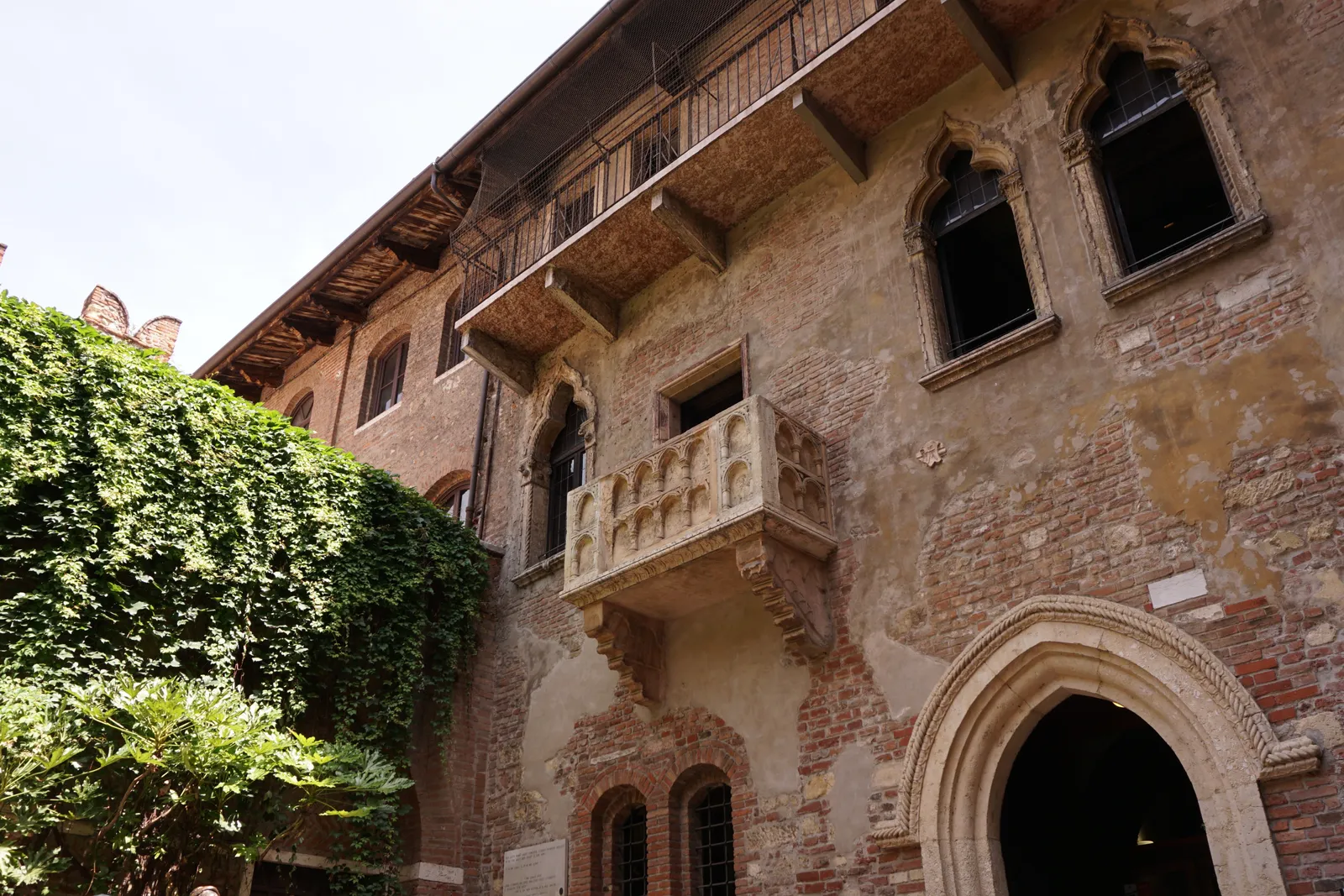
La Casa di Giulietta est une maison-tour en brique du XIVe siècle située Via Cappello 23, propriété de la Comune di Verona depuis 1905 et exploitée comme musée par les Musei Civici di Verona. L’association avec Shakespeare relève d’une fiction littéraire superposée — la maison d’origine appartenait à la famille Capello, et la similitude phonétique avec Capulet a été popularisée par les voyageurs des XVIIIe et XIXe siècles. Le célèbre balcon a été ajouté en 1939 par l’architecte Antonio Avena. Depuis le 1er avril 2026, l’entrée à la cour comme à l’intérieur du musée se fait par billets à entrée à heure réservée auprès du Teatro Nuovo sur la Piazzetta Navona. La visite dure de 30 à 60 minutes à l’intérieur de la maison, plus 15 à 30 minutes dans la cour.
Casa di Romeo est une demeure médiévale privée située sur Via delle Arche Scaligere, à l'angle des tombeaux Scaligeri (Arche Scaligere) et à 5 minutes à pied de Casa di Giulietta. Elle est associée par la tradition locale à la famille Montecchi — le nom historique que Shakespeare adapta en Montague — bien que les preuves historiques ne soient pas plus solides que le lien entre Capello et Capulet. Le bâtiment est une résidence privée dotée d'une façade gothique de briques et d'une plaque inscrite évoquant l'association shakespearienne. Il n'est pas ouvert au public : aucune entrée, aucun musée, aucun balcon à photographier. Les visiteurs s'arrêtent dans la rue, lisent la plaque, photographient la façade et poursuivent leur chemin.
Ce Que Vous Découvrez à Casa di Giulietta
Casa di Giulietta propose une expérience muséale structurée autour du balcon et de la statue en bronze de Juliette. Vous entrez par Teatro Nuovo, traversez le nouveau hall d'accueil et le foyer, puis débouchez dans la cour où se dresse la statue de bronze sous le balcon suspendu. À l'intérieur de la demeure médiévale, des salles ornées de fresques préservent le caractère du bâtiment du XIVᵉ siècle, du mobilier Renaissance de reproduction meuble les étages supérieurs, et une exposition centrale présente costumes et accessoires de l'adaptation cinématographique de Roméo et Juliette réalisée par Franco Zeffirelli en 1968. Un petit escalier mène au balcon lui-même — pièce maîtresse de toutes les photographies de lune de miel véronaises depuis 1939.
La visite suit le rythme d'un petit musée municipal. Aucune visite guidée officielle n'est incluse dans le billet d'entrée ; l'expérience se fait à votre rythme. Le mur de lettres et la boîte aux lettres de la cour, entretenus par les bénévoles du Club di Giulietta, occupent un angle de la cour, et la tradition consistant à frotter la statue de bronze de Juliette pour attirer la chance perdure près de la réplique (le bronze original de Costantini datant de 1973 fut déplacé à l'intérieur en 2014). La photographie est autorisée partout. L'audioguide, disponible en supplément payant, approfondit l'histoire de la famille Capello et l'intervention architecturale d'Avena en 1939.
Ce Que Vous Découvrez à Casa di Romeo
Casa di Romeo constitue un arrêt photo de 5 minutes, non une destination. La façade gothique de briques s'élève directement depuis la rue médiévale, avec des fenêtres en arc et une lourde porte de bois insérée dans la maçonnerie. Une plaque municipale en italien et en anglais mentionne l'association shakespearienne et évoque la famille Montecchi. Le bâtiment étant privé, il n'y a ni tarif d'entrée, ni horaires d'ouverture, ni visite intérieure. Les visiteurs photographient généralement la façade, lisent la plaque, lèvent les yeux vers les fenêtres supérieures dépourvues de balcon, puis poursuivent leur route. L'arrêt complet dure de 5 à 10 minutes, photographies comprises.
La rue elle-même est l'une des ruelles médiévales les plus tranquilles de Vérone, ce qui constitue une partie de son charme. Là où Via Cappello et Piazzetta Navona connaissent un flux touristique soutenu, Via delle Arche Scaligere demeure suffisamment calme pour photographier sans autres visiteurs dans le cadre. Les tombeaux Scaligeri (Arche Scaligere) — monuments funéraires gothiques élaborés des seigneurs médiévaux de Vérone — se dressent immédiatement au bout de la rue, et combiner Casa di Romeo avec les Arche Scaligere et l'église adjacente Santa Maria Antica transforme un simple arrêt photo en un détour cohérent de 30 minutes dans la Vérone médiévale. Aucun billet n'est requis pour ces sites adjacents ; les Arche Scaligere s'observent depuis la rue à travers leur grille en fer forgé.
Durée, Tarifs et Organisation Comparés
La Casa di Giulietta exige un billet à entrée à heure réservée et environ 60 à 90 minutes sur place. La Casa di Romeo ne nécessite aucun billet et environ 5 à 10 minutes sur place. Les deux sont à 5 minutes de marche l’une de l’autre, ce qui rend leur combinaison simple. Les visiteurs qui privilégient le pèlerinage shakespearien à Vérone font généralement les deux ; ceux qui privilégient le sightseeing culturel général sautent souvent la Casa di Romeo, car l’expérience est très courte. Il n’y a aucun risque pratique à garder la Casa di Romeo pour la fin, puisqu’aucune réservation n’est nécessaire et que la façade est visible à toute heure du jour ou de la nuit.
Il convient de considérer ces deux sites comme faisant partie d'une même tradition de tourisme littéraire plutôt que comme des concurrents. Tous deux ont été greffés sur des demeures médiévales par l'imaginaire des XIXe et XXe siècles cherchant à ancrer la Vérone fictive de Shakespeare dans une architecture réelle ; tous deux affichent honnêtement leur histoire stratifiée pour qui sait observer. Le voyageur qui visite la Casa di Giulietta, la Casa di Romeo, les Arche Scaligere et les ruelles médiévales du centre historique comprend de façon cohérente comment Vérone a transformé une pièce fictive en lieu réel sur deux siècles. Celui qui n'a le temps que pour un seul site devrait choisir la Casa di Giulietta — elle réunit le balcon, la statue de bronze, l'intérieur muséal et le mur de lettres, autant d'éléments qui n'existent nulle part ailleurs.
Combiner les deux en une matinée
L'itinéraire combiné le plus efficace débute à l'ouverture à 09:00 au Teatro Nuovo (ou à 14:00 le lundi). Consacrez 60 à 90 minutes à la visite complète de la Casa di Giulietta — cour intérieure, musée, balcon. À la sortie sur Via Cappello, tournez à droite et marchez 2 minutes vers le nord jusqu'à Piazza delle Erbe, la place médiévale du marché. Traversez Piazza delle Erbe, empruntez Via Cairoli jusqu'aux Arche Scaligere, et la Casa di Romeo se trouve quelques pas plus loin sur Via delle Arche Scaligere. Le circuit complet — intérieur de la Casa di Giulietta, traversée de Piazza delle Erbe, Arche Scaligere et Casa di Romeo — se réalise confortablement.
Ajoutez la Torre dei Lamberti (la tour de brique de 84 mètres sur Piazza delle Erbe avec ascenseur vers la plateforme panoramique) si vous souhaitez une photographie aérienne du centre historique et du méandre de l'Adige. Ajoutez Sant'Anastasia (la plus grande église gothique de Vérone, à 5 minutes à pied des Arche Scaligere) si vous souhaitez un contrepoint médiéval-religieux au circuit profane shakespearien. Une matinée complète Shakespeare-et-Vérone-médiévale se terminant aux Arènes de Vérone pour déjeuner Piazza Bra constitue une visite d'une journée au rythme bien équilibré et libère l'après-midi pour Castelvecchio ou le Théâtre romain de l'autre côté du fleuve.
Questions fréquentes
Peut-on entrer dans la Casa di Romeo ?
Non. La Casa di Romeo est une résidence privée située Via delle Arche Scaligere. La façade et la plaque sont visibles depuis la rue à toute heure, mais l'intérieur n'est pas ouvert au public et aucun billet n'est vendu.
La Casa di Romeo vaut-elle la visite ?
Si vous avez déjà réservé la Casa di Giulietta et que l'aspect shakespearien vous intéresse, oui — il s'agit d'une marche de 5 minutes et d'un arrêt photo de 5 à 10 minutes. Si vous ne disposez que de peu de temps à Vérone et ne suivez pas spécifiquement le circuit Shakespeare, la façade seule constitue rarement un arrêt mémorable.
Quelle distance sépare les deux maisons ?
Environ 5 minutes à pied. L'itinéraire part de la Via Cappello vers le nord en direction de la Piazza delle Erbe, puis se poursuit vers l'est le long de la Via Cairoli jusqu'à la Via delle Arche Scaligere où se trouvent la Casa di Romeo et les tombeaux Scaligeri.
Y a-t-il un balcon à la Casa di Romeo ?
Non. Le célèbre balcon se trouve à la Casa di Giulietta — et même ce balcon a été ajouté en 1939 par l'architecte Antonio Avena, il ne s'agit nullement d'un élément médiéval d'origine. La Casa di Romeo ne possède aucun balcon.
Faut-il un billet pour la Casa di Romeo ?
Non. Il n'y a ni entrée, ni billet, ni horaires d'ouverture. La façade est visible depuis la rue publique et la plaque commémorative est rédigée en italien et en anglais.
Laquelle de ces demeures appartenait réellement aux familles historiques de Roméo et Juliette ?
Aucune des deux, au sens documentaire du terme — Roméo et Juliette sont des personnages de fiction. La famille Capello (associée à la Casa di Giulietta) et la famille Montecchi (rattachée par la tradition locale à la Casa di Romeo) sont de véritables familles véronaises médiévales, mais aucune preuve documentaire ne les relie à l'intrigue de Shakespeare au-delà de la simple ressemblance phonétique de leurs noms.
Puis-je visiter les deux maisons ainsi que les Arènes en une seule journée ?
Oui, aisément. Une journée véronaise typique consacrée à Shakespeare et aux Arènes s'étend sur 4 à 5 heures : Casa di Giulietta dès l'ouverture à 09:00, promenade jusqu'aux Arche Scaligere et à la Casa di Romeo vers 11:00, Piazza delle Erbe et déjeuner vers 12:30, visite des Arènes de Vérone en début d'après-midi. L'ensemble du parcours se fait aisément à pied.
Les Arche Scaligere nécessitent-elles un billet distinct ?
Les tombeaux sont visibles gratuitement depuis la rue à travers leur grille en fer forgé. L'accès à l'intérieur de l'enceinte est occasionnellement possible dans le cadre de la programmation des Musei Civici di Verona ; consultez le site de l'opérateur pour connaître les modalités en vigueur.
Existe-t-il des visites guidées pour le circuit Shakespeare combiné ?
Oui — des guides privés agréés de Vérone proposent des visites à pied combinées Casa di Giulietta + Casa di Romeo + Arche Scaligere, d'une durée généralement de 2 heures. Ces prestations s'organisent auprès d'opérateurs locaux agréés plutôt qu'à l'entrée du musée.
Quelle maison est la plus fréquentée ?
Casa di Giulietta — de loin. Elle figure parmi les trois sites les plus visités de Vérone, aux côtés des Arènes de Vérone et de la Piazza delle Erbe. Casa di Romeo, dépourvue de musée ou de visite intérieure, ne connaît qu'une fraction de cette affluence.